Sunday, August 31, 2008

Waiting for Godot - Samuel Beckett (1949)

A play that can be interpreted at many levels, I've always favoured the existentialist interpretation which deals with the meaning of human existence and the onus of each man to carry his own burden and make of his life what he can, however difficult it might be...
An excerpt I once knew by heart and could recite at the drop of a hat and to me, perhaps the most important part of the text...
VLADIMIR: But that is not the question. What are we doing here, that is the question. And we are blessed in this, that we happen to know the answer. Yes, in this immense confusion one thing alone is clear. We are waiting for Godot to come–
ESTRAGON: Ah!
POZZO: Help!
VLADIMIR: Or for night to fall.
(Pause.) We have kept our appointment and that's an end to that. We are not saints, but we have kept our appointment. How many people can boast as much?
ESTRAGON: Billions.
VLADIMIR: You think so?
ESTRAGON: I don't know.
VLADIMIR: You may be right.
POZZO: Help!
VLADIMIR: All I know is
that the hours are long, under these conditions, and constrain us to beguile them with proceedings which —how shall I say— which may at first sight seem reasonable, until they become a habit. You may say it is to prevent our reason from foundering. No doubt. But has it not long been straying in the night without end of the abysmal depths? That's what I sometimes wonder. You follow my reasoning?
ESTRAGON: (aphoristic for once). We are all born mad. Some remain so.
POZZO: Help! I'll pay you!
ESTRAGON: How much?
POZZO: One hundred francs!
ESTRAGON: It's not enough.
VLADIMIR: I wouldn't go so far as that.
ESTRAGON: You think it's enough?
VLADIMIR: No, I mean so far as to assert that I was weak in the head when I came into the world. But that is not the question.
POZZO: Two hundred!
VLADIMIR: We wait. We are bored. (He throws up his hand.) No, don't protest, we are bored to death, there's no denying it. Good. A diversion comes along and what do we do? We let it go to waste. Come, let's get to work! (He advances towards the heap, stops in his stride.) In an instant all will vanish and we'll be alone once more, in the midst of nothingness!

Sunday, August 17, 2008

Tanguy - Michel del Castillo (1957)


An autobiographical work by
Michel del Castillo, a Spanish born writer who writes in French, Tanguy is a powerfully moving novel highly reminiscent of The Diary of Anne Frank (due mainly to the child's point of view as opposed to that of the adult). Narrating in first person, the story of a young Spanish boy, Tanguy, the novel is set against the backdrop of the war.

The novel starts in Spain in 1939, during the Spanish civil war, when Tanguy is forced to flee the country with his mother because of her political affiliations. They find themselves in France, which is no less hostile. Forsaken by his father, Tanguy and his mother are arrested by the police and sent off to a camp for political refugees where life is difficult and they face many a hardship and insult. Finally able to escape, Tanguy's mother now decides to flee to London. In order to escape unnoticed from France, they must travel separately and Tanguy is thus separated from his mother. Discovered by the German troops he is packed off to a concentration camp where he endures a life of hunger, cold and forced physical labour that break his body and spirit, the only respite being in a young German pianist who befriends him and reminds him time and again not to hate for hatred breeds nothing but hatred.

After the war, Tanguy is sent back to Spain, Barcelona where he learns that his grand mother has recently passed away and there is no one else to take care of him. He is sent to a reformation school for juvenile delinquents and orphans, run by priests who are no less cruel and sadist than the Nazi "kapos." Bitter, Tanguy believes they are worse than the Nazis because these priests hide their sadism behind the facade of religion and confession, but that makes their sin no less. He succeeds in escaping along with a companion, but is forced to separate from his as well. This time around, he finds himself in a school run by a group of priests but unlike the reformation school, here, Tanguy is able to grow, learn and live comfortably. It is here, that he truly flourishes and finds friends and solace. But he is still not completely at peace and sets off again in search of the parents who had abandoned and forsaken him to such a bitter destiny. He does find them eventually, but only to realise that the years of hardship and horror experienced by him have built an impenetrable barrier between them.

An extremely poignant novel, Tanguy made me relive the horrors of the World War, the holocaust and the aftermath which was no less difficult but few talk about. On a more personal note, this is one of the very rare French novels that I've read completely and I think the rhythm, fluidity of prose and style of narration helped me just as much as the subject being dealt with...for me, the most noteworthy aspect of the novel was the poignancy of Tanguy's situation nuanced by his frantic efforts to lead as normal a childhood as possible in his circumstances and his hunger for human relationships, be those with the parents who cared naught for him, or the friends he makes on each step of his journey but is forced to leave behind and move on in his quest for answers and peace. A depressing read indeed, but an extremely moving one that I strongly recommend.

PS The novel in its English translation goes by the title of Child of our Time. I have simulataneously published a review in French on Accros de Français.

Sunday, August 10, 2008

My Family and Other Animals - Gerald Durrell (1956)

I like animals. I understand their importance in our ecological system. I even admire and appreciate certain species. But I wouldn't go as far as calling myself a generic animal lover, because frankly there are some whose existence is quite beyond my grasp. Lizards for example, or snakes, or crocodiles...basically the entire gamut of animals that are categorised as reptiles. And thus when I spotted a lizard in class one day I turned into an embarassingly nervous skittish foal who quickly hopped over to the other side of the class and ended up providing much more entertainment than usual to my students...and the very next day I was given a copy of Gerald Durrell's autobiographical My Family and Other Animals.

Skeptical at first, I started reading it not quite sure if I'd like it or even finish it. I did finish it, just a few days later, after having spent a few nights laughing and chuckling in bed at the anecdotes narrated by Durrell about his sejour in the Greek island of Corfu from 1935 - 1939, his colourful family and extended group of friends and above all, his adventures and experiences with animals. Gerald Durrell (younger brother of the far more famous Lawrence Durrell) spent several years in Corfu with his family, where he roamed at liberty in the countryside observing, absorbing, collecting, learning...often appalled and outraged with the latest animal he had decided to adopt, his family mostly supported his love for animals. The novel is full of interesting, entertaining and educating anecdotes that made me view animals in a whole new light. For instance, I would have never thought of a fight between a mantis and a gecko as anything worth watching, but Durrell presents it like a heroic episode between two mighty warriors and I must admit that despite my complete horror and skirmish disgust at the excruciating details provided I was impressed. His presentation of the turtles and their mating ritual tickled me pink, as did his descriptions of the rather aggressive bird they adopted.

My reading informs me that Gerald Durrell who later went on to become a very famous naturalist and is responsible for having recognised and saved some endangered species, apart from setting up the Durrell Wildlife Conservation Trust for his animals, wrote mainly because his brother urged him to do so. Lawrence Durrell, the established writer urged him to pen down his experiences as a naturalist and narrate the anecdotes as a means of financing his expeditions and sharing the knowledge he had gathered over the years. Had I not known this, I would have pegged the younger Durrell as just as talented a writer as his famous elder brother. I wish I had discovered Gerald Durrell earlier, but then as they say in my mother tongue (tongue-in-cheek) der sahi, andher nahin. Having enjoyed this one throughly, I do believe I am going to try and hunt down more of his fictional writing.

PS The customary excerpt is missing because I returned the book immediately after finishing reading it and am posting this nearly three weeks after...

Friday, July 11, 2008

The Penelopiad - Margaret Atwood (2005)

Margaret Atwood, steals yet again and presents us a delightfully tongue-in-cheek feminist version of an otherwise accepted, rarely questioned and highly glorified tale. Re-interpreting the Greek myth of Odysseus as a part of The Myths series, Atwood presents The Odyssey (originally written by Homer) from Penelope's point of view, in The Penelopiad.

Unlike her beautiful cousin, Helen of Troy, Penelope has never been a popular character in Greek mythology. Married to Odysseus, she is known mainly for having woven a shroud which she undid every night, for nearly 12 years in order to fend off her many suitors who wanted to marry her and usurp Odysseus' kingdom and her son, Thelemachus' inheritance. Synonymous with intelligence and fidelity, Penelope, otherwise didn't have a major role to play in Greek mythology. Atwood changes this, presenting to us Penelope's (untold) story right from her neglected childhood, to her marriage and the years she spent at Ithaca without her husband, struggling to survive against all odds, depending on her wit and pragmatism. Atwood thus presents Penelope as much more than merely a faithful wife. Interestingly Atwood does not paint Penelope as the flawless heroine but as human with flaws such as sibling rivarly and jealousy (towards Helen), vanity which makes her enjoy the flattery poured on her by the suitors and even the urge to give into the temptation and yield to her carnal desires.

Above all, Atwood brings to us the voice of the maids, who were hung by Odysseus and Telemachus. Guilty of disloyalty, the maid servants, who entered a life of slavery at childhood and were raped or forced to sleep with their master and any man he dictated, were condemned to death for having slept with Penelope's suitors in Odysseus' absence. In The Penelopiad they are given a chance to present their case and argue their innocence in a ballad as well as an extremely rivetting parody of a court room scene.

Succesfully manipulating several genres to serve her purpose of subverting a popular myth, Margaret Atwood comes up with another winner.

Monday, July 07, 2008

Slowness - Milan Kundera

Rare is it that I devour a book within a couple of hours. Rarer that I find myself unable to lift my eyes from a book when I am in a moving bus. Yesterday on my way back from the Tinsel Town I started Milan Kundera's Slowness and before I knew it, I had turned the last page, having spent two hours nodding in admiration at the weight in the words chosen to weave this delightfully tongue-in-cheek oeuvre!

A philosophical treatise that raises more questions than it answers, Slowness analyses slowness and speed, memory and speed, hedonism and exhibitionism, the art of (amorous) conversation and orgasms with a brilliantly cold detachment. At the same time, Slowness narrates two intertwined tales of seduction juxtaposed against another midsummer night's seduction in the 18th century...and all this is staged in the same castle where the narrator is spending the weekend with his wife and an entomologists' conference is taking place.

I loved the wicked humour in the exchanges between the two couples, especially in the scene between Vincent and Julia and was completely bowled over by the philosophical arguments on the various subjects.

A novel that fills you with grotesque horror at times yet forces an unbridled laughter out of you and succeeds in making you think and realise how shallow and pretentious and sordid modern civilisation can be and is, Slowness delights, enthralls and makes you bow down to the sheer genius that is Milan Kundera.

I leave you with the customary excerpt, though the urge to type out half the book is great:

Being among the elect is a theological notion that means: not as a matter of merit but by a supernatural judgement, a free, even capricious, determination of God, a person is chosen for something exceptional and extraordinary...

...the feeling of being elect is present, for instance, in every love relation. For love is by definition an unmerited gift; being loved without meriting it is the very proof of real love. If a woman tells me: I love you because you're intelligent, because you're decent, because you buy me gifts, because you don't chase women, because you do the dishes, then I'm disappointed; such love seems a rather self-interested business. How much finer it is to hear: I'm crazy about you even though you're neither intelligent nor decent, even though you're a liar, an egotist, a bastard.

The Patriot

I am standing for peace and non violence
Why the world is fighting fighting
Why all people of world
Are not following Mahatma Gandhi
I am simply not understanding
Ancient indian wisdom is 100% correct,
I shuold sayeven 200% correct,
But mordern generation is neglecting-
Too much going for fashion and foreign thing.

Other day i'm reading newspaper
(Everyday i'm reading Times Of India
To improve my English Language)
How one goonda fellow
Threw stone at Indirabehn
Must be student unrest fellow, i am thinking.
Friends, Romans, Cuontrymen, i am saying (to myself)
Lend me the ears.
Everything is coming-
Regeneration, remuneration, contraception.

Be patiently, brothers and sisters.
You want one glass lassi?
Very good for digestion.
With little salt, lovely drink,
Better than wine;
Not that i am ever tasting the wine,
I'm the total teetotaller, completely total,
But i say
Wine is for the drunkards only.

What you think of prospects of world peace?
pakistan behaving like this,
China behaving like that,
It is making me really sad, i am telling you.
Really most harassing me.
All menare brothers, no?
In India also,
Thuogh some are having funny habits.
Still, you tolerate me,
I tolerate you,
One day Ran rajya is surely coming.

You are going?
But you will visit again
Any time, any day,
I am not believing in ceremony
Always I am enjoying your company.
-
Nissim Ezekiel

Read some of his other poems here.

Tuesday, July 01, 2008

Life Without Books Would Be A Mistake

I was born in a book. This is not a metaphor. I was born to myself by reading. I was born to rejection, to excess, to enigmas, I was born to the incomprehensibleness of things, I was born to what is called the inner life thanks to a book. I was ten. I remember it well. The book was called "Sans Famille" (Nobody's Boy) by Hector Malot.
I belong to books. All other affiliations reduce me and sut me in. All other affiliations fill me with horror. The soil, blood, race, the family fill me with horror.
I belong to books. To the books I read in my childhood. To the ones that have marked the seasons of my life. I belong to the books of Cervantes, Rabelais, Pascal, Faulkner and Bernhard. But I belong too, to the books that I haven't read and which have founded the language that I speak, its spirit, its colours, its pace.
I belong to books. When the world is noisy, books give me peace. When life no longer makes sense, books know how to laugh at it.
As there is no god to take me in, no master to guide me, no root in the soil to hold me, I fear being crushed in the immanence of things. But the uneasy voice of great books leads me towards an unknown that calls me and keeps me moving forward.
I read, I live. Life without books would be nothing but a mistake. My life without books would be inconceivable. Like an existence with no secrecy. Like day without night.
Books are my day and my night.
-Lydie Salvayre
This quarter's issue of Label France has a special dossier on Books and People and has a special feature "Words of writers" in which 10 authors reacted to the question "What place do books have in your life?"
Read what other writers have to say (in French) at the official Label France site.
Disclaimer - I haven't translated the text. I merely copied it from the English edition I picked up at AFP..

Being Alone With The World In Your Hands

Reading is absenting yourself from the world
reading is finding the world again
reading is being alone with the world in your hands
reading is being alone in the company of others
reading is thinking before acting
reading is taking the time to think
reading is imagining
imagining is putting yourself in the Other's place
reading is an act of humanity
reading is being with the other and with yourself
reading and writing is the beginning of belonging to the world
everyone should be able to read and write in their own language
reading is being alone and yet being part of the world

Writing is responding to this solitude
without filling it
without imagining that you are making up for it
writing is facing the void
writing is being at the reader's side
not in his place or above him
writing is relying on intelligence
writing is also being alone
but not totally isolated
writing is seeking the Other in yourself
you can turn it into an illness
you can turn it into a job
you can turn it into a rapture
writing is uncontrollable but it is grammatical
writing is asking questions with no answer
writing is answering questions that have not been asked
writing is rejecting the words of harmony as well as those of discord
writing is sowing disorder by reviving language
writing is an act of humanity and a curse
writing keeps me upright but also digs gulfs
- Marie Darrieussecq (French Writer, Psychoanalyst)

Thursday, June 19, 2008

From "Slowness" (1995),

Why has the pleasure of slowness disappeared? Ah, where have they gone, the amblers of yesteryear? Where have they gone, those loafing heroes of folk song, those vagabonds who roam from one mill to another and bed down under the stars? Have they vanished along with the footpaths, with grasslands and clearings, with nature? There is a Czech proverb that describes their easy indolence by a metaphor : 'They are gazing at God's windows.' A person gazing at God's windows is not bored; he is happy. In our world, indolence has turned into having nothing to do, which is a completely different thing: a person with nothing to do is frustrated, bored, is constantly searching for the activity he lacks.

In everyday language, the term 'hedonism' denotes an amoral tendency to a life of sensuality, if not outright vice. This is inaccurate, of course: Epicurus, the first great theoretician of pleasure, had a highly sceptical understanding of the happy life: pleasure if the absence of suffering. Suffering, then, is the fundamental notion of hedonsim: one is happy to the degree that one can avoid suffering, and since pleasures often bring more unhappiness than happiness, Epicurus recommends only such pleasures as are prudent and modest. Epicurean wisdom has a melancholy backdrop: flung into the world's misery, man sees that the only clear and reliable value is the pleasure, however paltry, that he can feel for himself: a gulp of cool water, a look at the sky (a God's windows), a caress.

- Milan Kundera

Tuesday, June 17, 2008

La Langue Française

Why is French such a complicated language(with such impossible to conceive pronounciations)?

Oft has this question been posed to me and I've always shrugged in response, saying that the people responsible have long been interred and are by now decomposed to the point that even if you tried tracking them down in hell (they couldn't have gone to heaven, surely, after having been this cruel and come up with such impossible words!), there wouldn't be much of them left to question. An answer that has frustrated many of my students, I'm sure.
I finally have the beginnings of an informed answer, thanks to,
The Story of French, by Jean-Benoît Nadeau and Julie Barlow, a brilliant treatise on the evolution of the language I teach and love, but often do not fathom!


According to historian Ferdinand Brunot, members of the Academy steered away from phonetic spellings because they were afraid of looking ignorant of the historical roots of a word. But this orientation was also the expression of a class struggle. The lettered class promoted complicated spellings as a way of holding onto power; by making it hard to learn French, they made it harder for anyone outside their class to enter the circles of power.


Bloody snobs, is the first reaction, isn't it? But to understand this better, I must explain some more, even if briefly. French, as the language we know today, hasn't always existed in this form. Far from it infact...the language of the common people, patois, or the regional languages were consciously removed from first, the courts and then the common parlance by François I in 1593 with the Ordinance of Villers-Cotterêts. Thus began the process of imposing a single language on the people, which gradually became purer in form.

Interestingly, while it is commonly thought that L'Académie Française was responsible for the purification of the language, the entire credit can not be given to them.
François de Malherbe started the process, which was later carried on by his followers. A true tyrant when it came to language, it is said, he spared no one in preaching the "bon usage du mot," not even the King! The process of purifying the language was later carried forward by enthousiasts and purists and thus was formed the Académie Française. Interestingly (again), it is widely and commonly thought that Cardinal Richelieu established the Academy in 1635, but the real founders of the Academy infact were Valentin Conrart and his friends.Richelieu offered his support, which they were obliged to take, coming as it was from the Cardinal itself and thus, they became a public institution from a small, private club that met to discuss the language and create a dictionary for the language. This, in fact, became one of the main missions of the Academy even though the Academy's dictionaries have never really been respected, published as they are after decades at times and often with outdated information.

Yet another interesting anecdote to narrate before I go back to the book:

The word anglais (English) was missing from every edition, but is expected to appear in the latest edition, slated for release in 2010s.
Now that's what you call pure French snobbery.

Monday, June 16, 2008

Booked by the Mother Hen

Tagged by Extempore, a.k.a the Mother Hen, to :-
  1. Pick up the nearest book.
  2. Open to page 123.
  3. Find the fifth sentence.
  4. Post the next three sentences.
  5. Tag five people, and acknowledge the person who tagged you.

She declares having struggled with the choice of book since she often reads more than one book at a time. I must admit, a similar dilemma awaited me, since my bed-side table currently hosts a couple of Penguin's Great Loves series, The Story of French as well as Margaret Atwood's Penelopiad...and then I stopped and asked myself why I was confused. No prizes for guessing which book this is coming from...

"Figuratively speaking, of course. Making up for all those mangled corpses. I hadn't realised you were capable of guilt."

Quintessential Margaret Atwood, this is from an exchange between Penelope and her much more famous cousin, Helen with reference to the battle of Troy and the thousands who were massacred because of her vanity/folly. A detailed review of the novel shall follow in a couple of days :-)

I now pass on the baton to Idle Mind, Jo, Madusa, Pranab and Wandering Dervish.

Friday, March 21, 2008

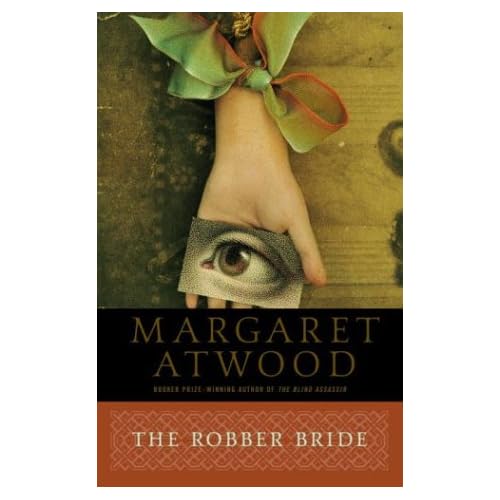
The Robber Bride - Margaret Atwood (1993)


Margaret Atwood’s The Robber Bride, offers us a feminist version of the fairy-tale The Robber Bridegroom. Familiar with the world of fairy tales, this isn’t the first time Atwood has been inspired by one, having spun off the Blue Beard tale in her collection of short stories, Blue Beard’s Egg. While the original fairytale is about a band of robbers with predatory, cannibalistic characteristics, here it is a woman who preys on men and sucks their life force out of them.

The story starts at a restaurant named Toxique, where three unlikely friends meet up for their monthly lunch - Tony, a diminutive war historian, Charis, a flower-child who believes in the powers of the soul and Roz, an entrepreneur with Catholic-Jewish origins. What unites the three is their experience with Zenia, who has over a span of three decades entered and wrecked havoc in the lives of each one of them, draining them on the personal front, making away with their men, as well as financial front, cheating, robbing, embezzling them of money and resources. It is almost apt then, that Zenia makes her re-appearance after having faked her death some years ago, at Toxique, for what is she after all, if not a toxic substance that has poisoned their lives, leaving them scarred?

Justifying her choice of a “villainess” who wrecks havoc instead of the standard fearsome villain (à la Blue Beard), Atwood questions the disappearance of the Lady Macbeths and Ophelias from the gory world of literature, saying that presenting a woman in dark shades doesn’t mean you are anti-female, merely that you truly believe in the equality of the sexes. “Equality means equally bad as well as equally good.” Zenia, is an embodiment of the evil in every way possible – armed with a beauty and an “aura” that men can’t resist, she knows how to work the field (pun intended), choosing her victims carefully, doing her homework well, leaving no chance of failure once she’s on the battle field, slipping through their defenses, disarming them skilfully before launching her attack. The novel, built in a Russian doll structure, slowly unveils the individual tales of Tony, Charis and Roz, revealing a horrifying tale of childhood neglect and abuse that has moulded them into the women they are, as well as their own encounter with Zenia, coming to a full-circle with the death of Zenia.

I embarked on the Atwood journey in 2004, with The Handmaid’s Tale and there has truly been no looking back, for each and every on of her books has held me in their spell. Witty, grotesque, chilling and horrifying, the novels have made me laugh with delight and sent cold shivers of horror crawling down my back moments after. Each and every book has been devoured, leaving my literary senses satisfied and satiated. The Robber Bride appealed particularly for several reasons. Tony, as a character – the tiny woman who faded into the walls but harboured an unlikely passion for her size and gender, and could methodically, unsentimentally chart inquisitions and conquests and recount tales of blood and gore, appealed immensely, making for a strong and rich character. I must confess, the choice of the female villain also tipped the scales - having always found fascinating the idea of the Femme Fatale, the she-devil who twists her victims around, wrecking complete havoc in their lives, Zenia, as the villainess was as perfect as she could get.

Would I recommend the book? Indulging in redundant questions are we? After The Handmaid’s Tale, The Robber Bride, in my opinion is her best work.

Sunday, February 10, 2008

From the Literary Desk

Oft do I miss my Literature days, the thrill of discovering yet another brilliant author, the awe that coursed through my veins discussing the genius behind the words, the complete satisfaction after having discussed, interpreted and analysed a particular work. The module on francophone literature that I had taken up during my stage at Montpellier not only gave me the opportunity to go back to those days, but also made me realise that without literature in my life, it is quite incomplete. While several incidences kept me away from literature after my return, and my failure to read as fast as I used to disappointed me greatly, the persistent prodding by someone whose opinions and advice mean much to me, made me turn once again to the world of literature, to read (steadily and constantly if not as voraciously as before) and to widen my horizons. The Literature Course recently started at AFP has given this attempt a further boost – we are working with Charles Perrault’s fairy tales from The Mother Goose Tales. I wasn’t very sure what I should expect from the course, and I almost backed off (but once again the said person prodded me on and I stuck around much to my contentment) but I am absolutely delighted with what we are doing and what I’ve been exposed to and what has been brought back into my life. Just being back in a class, with a teacher whose knowledge is worthy of much admiration, reading and discussing a literary work is joy enough for me – but when it is something in which I take keen interest, brings back my knowledge and allows me to put that as well as my own intelligence and literary instincts to work…it really couldn’t get better!

I already had some background in the origin of fairy tales having discussed the genre when we studied African, Australian and Canadian folk tales at the MA level, and knew that the fairy tales we know today (mainly those penned by the
Grimm brothers and Hans Christian Anderson) find their origins in the oral tradition of narrating stories (often very grisly and horrifying) around a fire to keep the guards awake and entertained through the night, as also in the famous Arabian Nights. It really is fascinating how these tales have evolved to a point that today we recognise them as children’s stories, despite their completely different origins. While I also knew that many versions of these fairy tales exist (no need to look far – we already know about two such versions, those of Charles Perrault and the Grimm brothers) I was really amazed to find out just how shocking (and sometimes feminist) the earlier versions were – for instance, did you know that in the earliest version of the Sleeping Beauty, a married prince rapes her while she’s in her induced slumber and it’s one of the two progeny from this illegitimate relationship that finally wakes her, and not the prince? Or that the oral version of the Red Riding Hood has an ingenious and smart girl who saves herself (and her grandmother) from the wolf and has no need of the Grimm brothers’ woodcutter to do the needful?

Apart from this, the professor, who herself is keenly interested in the origin of languages and etymology, has reawakened my own slumbering interest in the subject and made me finally pick up and start reading
The Story of French by Julie Barlow and Jean-Benoît Nadeau, a book that I purchased over a year ago and has been gathering dust ever since. Needless to say, the book has completely grabbed my interest and I’m making my way through it steadily, absolutely delighted with what I’m reading, coupled with information I garner in class!

I’m simultaneously working my way through my fifth Margaret Atwood,
Cat’s Eye as well as an anthology of Moroccan poetry. I must admit that the tone of some of the poems took me by surprise, especially those that dealt with the themes of God and carnal pleasures. I was struck by the frankness of Mohammed Achaari’s “Douceur Sauvage” a poem of complete raw sensuality, and the hard-hitting tone of Mohammed Aziz Lahbabi’s “Dieu, l’Absolument Grand” in which God has been stripped bare of his mercy and has instead been presented as someone who is not only indifferent to his believers suffering, but almost cruel and inconsiderate in his demands, and as someone who has imposed a burden of responsibilities on us without so much as asking us our opinion. Perhaps I’m indulging in prejudices, but I found it really remarkable to see such themes being tackled with such frankness and almost brutality by poets from a Muslim culture. Whether they are representative of a small minority of rebellious thinkers in their countries or whether they truly represent a changing trend of thoughts and attitudes in their country, I do not know. What I do know, is that their work is brilliant and worthy of recommendation.

Saturday, December 22, 2007

Perfume – Patrick Süskind (1985)

In the period of which we speak, there reigned in the cities a stench barely conceivable to us modern and women. The streets stank of manure, the courtyards of urine, the stairwells stank of mouldering wood and rat droppings, the kitchens of spoiled cabbage and mutton fat; the unaired parlours stank of stale dust, the bedrooms of greasy sheets, damp featherbeds, and the pungently sweet aroma of chamber-pots. The stench of sulphur rose from the chimneys; the stench of caustic lyes from the tanneries, and from the slaughterhouse came the stench of congealed blood. People stank of sweat and unwashed clothes; from their mouths came the stench of rotting teeth, from their bellies that of onions, and from their bodies, if they were no longer very young, came the stench of rancid cheese and sour milk and tumorous disease. The rivers stank, the marketplaces stank, the churches stank, it stank beneath the bridges and in the palaces. The peasant stank as did the priest the apprentice as did his master’s wife, the whole of the aristocracy stank, even the King himself stank, stank like a rank lion and the Queen like an old goat, summer and winter. For in the eighteenth century there was nothing to hinder the bacteria busy at decomposition, and so there was no human activity, either constructive or destructive, no manifestation of germinating or decaying life, that was not accompanied by stench.


And thus begins one of the most sensuously delightful novels I have read. Patrick Süskind’s Perfume, first published as Das Parfum in 1985, and translated into English by John E.Woods in 1986 takes the reader on the most mesmerising journey into the world of perfume. The novel’s protagonist, Jean-Baptiste Grenouille, born on the streets of 18th century Paris as we could never imagine it, curiously enough possesses no human odour which leads him to being rejected by everyone who comes in contact with him. But if he himself as no personal scent, he is blessed with the sharpest olfactory sense and can smell distinguish between the smallest and slightest of odours.

…when the wind brought him something, a tiny hardly noticeable something, a crumb, an atom of scent than the scent itself; no even less than that: it was more the premonition of a scent that the scent itself – and at the same time it was definitely a premonition of something that he had never smelled before. He backed up against the wall, closed his eyes and flared his nostrils. The scent was so exceptionally delicate and fine that he could not hold onto to it; it continually eluded his perception, was masked by the powder-smoke of the petards, blocked by the exudations of the crowd, fragmented and crushed by the thousands of other city odours. But then, suddenly it was there again, a mere shred, the whiff of a magnificent premonition for only a second…and it vanished at once. Grenouille suffered agonies. For the first time, it was not just that his greedy nature was offended, but his very heart ached. He had the prescience of something extraordinary – this scent was the key for ordering all odours, one could understand nothing about odours if one did not understand this one scent, and his whole life would be bungled, if he, Grenouille, did not succeed in possessing it. He had to have it, not simply in order to possess it, but for his heart to be in peace.

The odour came rolling down the rue de Seine like a ribbon, unmistakably clear, and yet as before very delicate and very fine. Grenouille felt his heart pounding, and he knew that it was not the exertion of running that had set it pounding, but rather his excited helplessness in the presence of this scent. He tried to recall something comparable, but had to discard all comparisons. This scent had a freshness, but not the freshness of limes or pomegranates, nor the freshness of myrrh or cinnamon bark or curly mint or birch of camphor or pine needles, nor that of a May rain or a frosty wind or of well water…and at the same time it had warmth, but not as bergamot, cypress or musk has, or jasmine or narcissi, not as rosewood has or iris…This scent was a blend of both, of evanescence and substance, not a blend, but a unity, although slight and frail as well, and yet solid and sustaining, like a piece of thin, shimmering silk…and yet again not like silk, but like pastry soaked in honey-sweet milk – and try as he would, he couldn’t fit those two together: milk and silk! This scent was inconceivable, indescribable, could not be categorised in any way – it really ought not to exist at all. And yet there it was plain and splendid as day. Grenouille followed it, his fearful heart pounding, for he suspected that it was not he followed the scent, but the scent that had captured him and was drawing him irresistibly to it.

Grenouille’s quest for the “perfect” scent takes him on a mesmerising journey of discoveries, till he realises that the scent that can drive anyone wild with desire and that makes men worship the ground the wearer walks on is that of a virgin girl and thus begins a horrifying quest to possess that scent. He cold-bloodedly murders several young women in order to possess their scent, all the while working his way in the perfume industry, learning how to extract and preserve perfumes from the best in the industry in Paris and later Grasse, the capital of perfumes in 18th century France. The novel takes on a horrifying twist when he finally succeeds in concocting the perfume for himself.

From the very first page I was entrapped in the overwhelming descriptions that took me on my own journey of olfactory discoveries, so powerful was the imagery, as is evident from the brief excerpts I have pasted here. The ease with which Süskind has woven in the cold menace into a sublimely beautiful prose is remarkable. The novel makes you alternate between the desire to lose oneself in the world of perfumes and a creepy horror at the drama unfolding before your eyes. Perfume, is unlike any other novel I’ve read, and definitely very high on my list of recommendations.

Saturday, December 15, 2007

The Girl from the Chartreuse – Pierre Péju (2005)


Translated by Ina Rilke from the French original La Petite Chartreuse (2002), The Girl from the Chartreuse is a heart-breaking story about Vollard, a book-seller who accidentally runs over a 10-year old girl with his van. The novel revolves around the three protagonists of Vollard, the little girl Éva and her mother Thérèse. Struck by the accident, Vollard reads fairytales to Éva, who sinks into coma after the accident, in the absence of her mother a rather aimless wanderer who abandons her child in her search for her own identity.

A profoundly moving novel that deals with the themes of life, childhood, loneliness and above all the question of how to accept oneself and understand differences, what struck me the most about the novel was not the story, as much as the sheer poetry of the oeuvre. Pure brilliance shines through every page, as Péju evokes tears with his poetic prose and makes your heart ache at Éva’s situation and Vollard’s loneliness and his pain. Poignant and beautiful, this is a book worth reading.

As the tradition goes, I leave you with an excerpt that has stayed with me even a year after I first read the book. It won’t take a genius to understand why…

"The Verb To Be" was the name of an old bookshop. A murky place, due not to a lack of lighting but to all the nooks and crannies. A deep space with dark,worn floorboards and secluded niches. Books everywhere, spread on tables and upright in rows, thousands of silent observers on wooden shelves.
An ongoing battle between dust and the printed word at "The Verb To Be," cardboard boxes overflowing with books, piles of volumes threatening to topple. Anarchy reigning supreme. Grandiose anarchy. A profusion of genres and titles. A joyous alchemy. It was here that people could drop by any day to procure their reading matter,highbrow or popular, arcane or classis, in exchange for a modest sum.

I rest my case…

Thursday, August 31, 2006

Alias Grace - Margaret Atwood (1996)

I really didn’t expect to come away impressed this time, specially when I was still crawling slower than a snail through the book a 100 pages down – but Jesus, this woman knows how to spin her tales, for just when I was beginning to desultorily flip the pages and start preparing myself to either trudge through the book or abandon it completely, she reached out and ensnared me in the fine web of her words. I put the book down a couple of hours back, and I knew the smile on my face mirrored pure content. I’ve just spent the last one hour reading about the history behind the novel and am craving more fodder to feed this hunger.

The novel, is based on a true story – the protagonist Grace Marks, has been modeled after a woman of the same name in the 19th century who was convicted for murdering her employers in the most brutal fashion. A sensational story in its time; it captured the attention, imagination and curiosity of people across Canada, USA and UK and kept the presses running hot for months at end. The novel takes off rather peacefully, gradually building up its pace and pulling you deeper into its whorls. Sticking quite faithfully to contemporary reality, Atwood presents 19th century Canadian society, struggling to find its feet with the shadow of its past looming large over it, and the big brother from down south ever ready to stamp down its burgeoning identity. In a time when poverty ran rampant and standards of morality were flexible, the country convicted a young girl for murder, painting her as black as they could, even while they struggled painstakingly to bleach clean their own dirty linen – the forays into an every-increasingly open world of psychology and science which clashed openly with old beliefs and superstitions about the mind, make the novel all the more interesting.

I can’t say this one impressed me as much as the previous three - the plot, could have been tightened a little, specially at the beginning, where I feel she has spent too much time trying to build up her characters. However, the characters truly stand out on their own – every last one of them, even the non-descript Ms Faith Cartwright who only appears as a mention in letters. Dr Simon, the doctor who set out to understand the mysteries of the mind and ended up losing his way in its labyrinth; Nancy Montgomery, the housekeeper with a murky past and murkier present; Thomas Kinnear, the apparently gentile man who paid for his sins; Mary Whitney, whose vibrant presence first lit up the plot and whose shadow haunts it right up to the last page…and ofcourse Grace Marks, who struggles above the squalor and misery of her world, pulled down time and again - she does succeed in finding peace at the end.

The historical details and characters did the trick this time – read it if you have a taste for historical novels with strong characters, and if you have a feel for Canada’s social, spiritual and political history.


Links for Extra Reading :-
Letter written in 1843 describing the murder
Grace Mark’s interview after she was released from prison

Thursday, June 01, 2006

Lady Oracle – Margaret Atwood (1976)

The third Margaret Atwood I’m reading after Handmaid’s Tale and Bluebeard’s Egg, it has lived upto my expectations. When I started the novel I didn’t expect it to hold my attention for long – I was sure that one author couldn’t possibly churn out novel after novel, all of which would succeed in pulling me into the intricate mesh of its plot, make my chuckle, smile, shed the occasional tear…feel. Margaret Atwood is apparently a pro at that, for when I finally did give Lady Oracle the attention it deserved, I devoured it in one sitting, one long cozy Sunday afternoon.

If Handmaid’s Tale sent shivers down my back, and Bluebeard’s Egg captured my imagination, Lady Oracle took me spinning along the fantastic world of Joan Foster, a closet-writer and bored wife of a confused communist. Going back and forth in time, the novel traces Joan’s life right from her strange, lonely childhood, her love-hate relationship with her own body/image to her adult life, her love life and her career. Her trysts with blackmailing reporters, strange lovers, a serious literary career in place of her more successful career as a Costume-Gothic novelist, not only gripped my attention, but had me chuckling and yes, at times, even rolling with laughter. And yet, the novel isn't meer candy floss material - there lies beneath the main text a very obvious subtext with a very obvious feminist text and a tongue-in-cheek parody of literary forms and hence literary snobbery. (But then, that's evident, since this is an Atwood oeuvre we're discussing!) Atwood’s descriptions are par excellence, the way she twists the plot is sheer genius – there isn’t a single moment in the book where I could predict what would happen next, and definitely not even a nano-second when ennui could possibly set in vis-à-vis the narrative.

The Globe and Mail says in its review:-
“Read it for its gracefulness, for its good story, and for its help with your fantasy life.”

Read it for all that – but read it mainly for Atwood’s genius!

Sunday, May 07, 2006

The Fairy Tale World of Children's Literature

Charles Perrault. Jean de la Fontaine. The Brothers Grimm.
Do these names mean anything to you? If not, then I must say you've had a very deprived childhood, for they are the names of the authors of the world's best-known and most-read fairy tales...or maybe not so deprived after all.

For quite a while now, even before the arrival of my nephew I'd been taking little jogs down memory lane thinking of all the stories that fired my imagination, the authors I adored and the books that were worn by repeated reading sessions during the vacations. On one of these many jogs, I chanced upon a collection of fairy tales by the Grimm brothers - the stories as it turned out, did complete justice to their name! I was quite appalled at the rather grim and depressing twist to all the stories! It was then, that I started thinking about the other fairy tales I knew - and surprisingly most of them had a depressing twist and very few actually had happy endings. I recently simplified the original story of Red Riding Hood (otherwise known as Le Petit Chaperon Rouge) by Charles Perrault, to narrate to my students and ofcourse it ends with Red Riding Hood being devoured by the wolf. My students didn't quite stomach the abrupt ending - most of them recalled a different, happier ending!

Over the centuries some of the stories have been adapted and changed to end on a more happy note - but the originals were not as optimistic in their outlook towards life. I was actually quite disturbed by this - to think that this was the stuff children grew up on, stuff that told of children being eaten up wolves and witches, of wishes granted by fairies being wasted because of one's foolishness, of nasty stepmothers and evil godmothers! But then I realised that they didn't present a lop-sided image of the world (though imaginary) where everything went well and everyone was good. While some stories had grim endings, others ended on a happy note. Compare Red Riding Hood and The Sleeping Beauty. Even Blue Beard, that scary tale of the evil man who killed his wives, ended on a happy note.

Further reading into the subject revealed that the stories when first written weren't necessarily intended for the juvenile audience they are associated with today - a majority of the stories were penned for the purpose of narration around the community fire, and many were actually transcribed after years of being passed down by the oral tradition. It would be interested to study this further and understand how and why the stories evolved into being stories for children!

Having recently read some new books under the genre of Children's Literature, namely, The Giver and Walk Two Moons given to me by Extempore, I have been trying to find books like that. I was in Manney's recently (perhaps the best bookstore in Pune, dating back to 1948) and browsing through the children's section, where apart from the Enid Blyton's, Malory Towers, St.Clare's, Anne of Green Gables and the many classics that I associate with my own childhood, I saw the other books that today fall under the genre of Children's Literature.Without taking names, I must say I was glad I was born in a different century when children's literature was not so complicated, and even with the grim endings fairy tales were that and nothing more!

Tuesday, April 25, 2006

Tagged!

I've done this before, on Geebaby, but my dear friend Aristera tagged me sometime back, reminding me that Keya too had tagged me before that, and I thought to myself - Why not?
Why not on Literary Mosaic, my much ignored second baby? So here goes, the Book Meme -

1. What is the total number of books you've owned? I've not counted them in a while, but I'd say more than 300.
2. What is the last book you bought? Anne of Green Gables (abridged and unabridged) for my two nieces. I've decided I must play the role of Bookie Aunty to the hilt! :-)
3. What is the last book you've read? The last book I read and finished reading was so long ago I don't even remember which one it was :-(
4. What are you currently reading? Lady Oracle by Margaret Atwood - never read so abysmally slow ever before! It's a disgrace!
5. What are the 5 books that have meant a lot to you or that you particularly enjoyed?
There are many, but from the top of my head right now :-
  • Little Women - Louisa May Alcott (for filling my childhood days with lovely images and for Jo - she rocks totally!),
  • Diary of Anne Frank (I think it's what got me interested in the Holocaust),
  • Wide Sargasso Sea - Jean Rhys (for making my world view so much larger),
  • The Lord of the Flies - William Golding (it's one of the rare classics that I devoured at one go!)
  • Golden Gate - Vikram Seth (I had my doubts about a novel in verse form, but all of them were laid to rest within the first ten pages through this one - Merci Aristera pour me donner ce roman!)
6. What book(s) would you wish to buy next? For now, I've promised myself to finish reading all those unread books on my bookshelf before buying any more books - let's see how long I stick to this resolution!
7. What book(s) caught your attention but you never had a chance to read? Oh, so many!
8. What book(s) that you've owned for so long but never read? The complete works of William Shakespeare, to start with...it's actually quite a long list. *embarassed*
9. Who are you going to pass this stick to and why? To all those who actually dropped by Literary Mosaic and read this post!

Monday, September 26, 2005

Rabindranath Tagore (1861-1941) - Selected Short Stories

Bengali poet, novelist, short-story writer, dramatist, painter, philospher and nationalist - Rabindranath Tagore is almost synonymous with the Indian Literature, being the first Indian to be awarded the Nobel Prize for Literature in 1913. He is also known as the founder of the experimental school, Shanti Niketan, in which he tried to impart an education that was a blend of Indian and Western traditions. The school went on to become the Vishwa Bharati University in 1921.

His collection of verse, titled Geetanjali, Song Offerings, was hailed by W.B Yeats and André Gide, bringing him the much deserved attention from Western Critics and paving the way to his Nobel Prize.

I've read many of his poems, particularly from the collection Geetanjali and it won't take a genius to guess what motivated that choice ;-) I've also read a couple of plays. Recently I finished reading a volume of selected short stories.

Tagore, known best for having liberated Bengali literature from the shackles of traditional rules and models based on ancient Sanskrit literature, is said to have been greatly influenced by his contact with the "humble life and their small miseries" of the village folk he was in contact with, after taking up residence near the Padma river. His stories have a distinctive poetic lilt, poignantly capturing those elements of their lives, laced with a gentle irony at times. Most of them deal with life of the middle-class family man, and often with the position of the not-yet emancipated Bengali woman in a patriarchal society.

Despite his apparently supporting stance towards women, his stoires have a rather one-dimensional view of women classifying them under the Madonna-Whore dichotomy. Many of his stories seem to be attempting to lift the veil from the hypocrisies of Bengali (and thus, Indian) society, yet their rather simplistic and one-dimensional view, in my opinion, restricts the goal from being achieved. Yet, when I think of other short-stories I've read dating from the same era (or before) that attempt similar reforms in ways of thinking, I have to accept that the trend in short-story writing was rather simple and one-dimensional.

Another possible reason, for what I perceived as a rather soft-handed approach in exposing the evils of a class-ridde, superstitious society, is the fact I am reading a translated work, and it is a well-acknowledged fact that translation robs most, if not all, the essence of the original. You only need to compare the impact of Tagore's Amaar Sonaar Bangla in its original and in its translated English version to understand this - you don't need to understand Bangla to feel the difference in the rhythm, tempo and most importantly the soul of the song in its two version. (Having said that, let me add that I'm still glad to have access to the translation - and feel rather grouchy when denied access to such translations of other pieces of literature and thought in vernacular languages that I come across!)

Tagore's collection of short stories didn't exactly lift me to ecstacies of literary delight, but I'm glad to have finally read the volume that has been on my Must-Read list for as long as I can remember! I guess I can now move on to other such works on that ever-increasing list :-)

(You can read more about Tagore on Wikipedia Here's what Brittanica online has to say about him and what the Nobel society says about him. )